







HOME
Apply Online | Campus E-mail
 

Celebrating 125 years

Order DWU History Book
Founders' Lecture
Photo Gallery - Founders' Convocation


Celebrating 125 years

Wesleyan Today

On Oct. 1, 2009 Dakota Wesleyan University kicked off its quasquicentennial – 125th anniversary – with a Founders’ Convocation celebrating the past and looking to the future. The new three-college system was dedicated, as was the Center for Talent Development. Three individuals received Distinguished Alumni Awards.


News Releases

Oct. 3, 2009 • DWU celebrates 125 years, presents awards to alumni
Spirituality and academics swirled together in a spirit of celebration as Dakota Wesleyan University faculty, trustees, alumni and students gathered to celebrate 125 years of the university and see four of their own receive alumni awards. Friday’s Founders’ Convocation in the Sherman Center provided a forum...more

Oct. 2, 2009 • DWU alumni prepare to celebrate school’s history, future this weekend
Robert Parkinson graduated at the top of his high school class in Highmore, and it didn’t take long for him to accept a scholarship to Dakota Wesleyan University. Now 100, Parkinson — who started college as a self-proclaimed “farm boy scared of his shadow” — said it was a decision that changed his life forever...more


The following is Provost Amy Novak’s Founders’ Convocation address.

Click HERE to view photo galleryIt was a crisp September day when the first aspiring Methodist pioneers left their comfortable communities in Iowa, Illinois, Minnesota and Wisconsin to move west to Dakota Territory to plant the seeds of Methodism in what some described as an unsettled, rough and rogue frontier. These early Methodists were depicted by biographers as “God-loving, high-minded and forward-looking.” They sought to sow the seeds of faith in the young and old alike and viewed education as the primary means of accomplishing this objective.

So, three years into the life of a small railroad community called Mitchell, founded near the banks of the James River, these ambitious Methodists began discussions of founding a college to, in their words, “give ever-increasing power, both spiritual and intellectual, to transform the generations to come.”

The Iowa Conference of the Methodist Church began discussions in the mid 1870s of how to bring education to the prairie. They passed resolutions to create a university like Cornell College in Iowa, described as “a school comprised of people of advanced Christian morals, and free from liquor and gambling saloons.” They sought to found a university in the Dakotas with “well-established academic programs in the classical, philosophical, scientific and civil engineering courses, and an excellent dormitory which could be secured for no more than $2 per week.” At a time when butter and eggs were about 6 cents, the university cornerstone was laid in 1884 with a foundational commitment of $60,000.

And so it was that in the summer of 1885, that the Methodist Conference of Iowa formally founded Dakota University. There is a rich history of this university on the hill which later became known as Dakota Wesleyan University (after an unsuccessful attempt to rename it Mitchell University). This legacy reveled with a frontier resiliency. Minutes of early meetings describe gatherings of “titanic intellects” toiling to create a university whose mission it would be to “lay the foundations for a new country.” Resiliency, persistence, and a commitment to the mission infiltrated the zeitgeist of this institution. Fires burned the original College Hall to the ground, several students jumped to their death in an attempt to escape the burning dormitory; legal predicaments at times burdened the university.

At one point desperate for money and students during the great depression, students paid professors with chickens, eggs, and promised them beef when the cattle were ready for butcher.
Students remained an active voice often challenging the administration. During President Sweetland’s tenure, students successfully protested the ban on dancing he had imposed, which later led to the president’s removal. When the war took students away, and in the fall of 1944 the doors of the university opened with 130 students, majors were cut and positions were eliminated all in an attempt to save what appeared to be an institution on the brink of closing.

Now 124 years later, our resiliency is marked by record enrollment, passionate students and academic excellence. DWU is at a historic milestone. Today we dedicate three distinct colleges of learning within the university: the college of Arts and Humanities, the College of Healthcare, Fitness and Sciences, and the College of Leadership and Public Service. The faculty of this institution embraced the value of creating clusters of experiences for students around various academic disciplines.

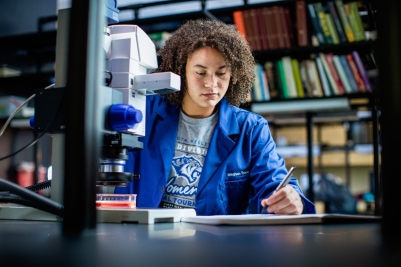
By organizing into three colleges, faculty were able to more effectively collaborate among themselves, which leads to distinct opportunities for DWU students in each of the colleges. These included expanded undergraduate research opportunities and internships in a variety of health sciences ranging from nursing to biology and statistics.

Students in the College of Leadership and Public Service have the opportunity to take specific coursework in leadership and ethics, as well as engage in a variety of cross-disciplinary service-learning projects that have ranged from teaching money management on the Indian Reservations to partnerships among psychology, education, criminal justice and human service students in support of the disabled, women and children. In the College of Arts and Humanities, students immerse themselves in global cultures by taking a required year of study in a foreign language and participating in study abroad experiences. Simply put, the new three-college structure enhances academic engagement of both our faculty and students.

As a university, when we inaugurate three colleges, we also reaffirm our dedication to our mission which aspires to create excellence in learning in the liberal arts and professional programs while simultaneously enriching the dialogue between mind and soul, developing whole persons, and promoting service to God and humanity. This mission still aligns with the vision set forth by our founders.

Whether one chooses to read poetry, decode a DNA gene sequence, act in a Shakespearean play, immerse oneself in an American Indian oral culture project, unravel the mysteries of the human brain, or engage in discussions about the ethics of contemporary business, a Dakota Wesleyan education transcends the textbook and a mere memorizing of facts: each college is prepared to enable the student to think independently, to make sound judgments, and to critically assess issues. Learning in the DWU environment becomes a dialogue in which each of us are humble participants, discovering new perspectives, expanding individual horizons, and gleaning insights into the interface between our intellect, our soul, and our body.

As our early pioneer founders desired, to be educated at DWU is to be transformed. The inauguration of three colleges designed to create distinct student experiences which engage the world’s most profound complexities is at the heart of the founders’ original intent: developing a university to help “build this new country.” We are the pioneers of the next 125 years. How will we choose to be remembered in the rich legacy of this institution? How will students be transformed by the learning opportunities we create? May God inspire our efforts to educate the whole person and may each of us set the world ablaze with our passion to learn, lead and serve our university, our community and our world.

Dakota Wesleyan University
1200 W. University Ave
Mitchell, SD 57301
800-333-8506
HOME
Copyright © DWU
Website by: DaveV
Last updated: 2/18/10
605-995-2600