








 |
 |
|
 |
 |
 |

Biochemistry
uses the combined knowledge of biology, chemistry and genetics to investigate
the complexity of the life processes of animals and plants. You’ll
be prepared for several postgraduate activities, including graduate
study in the life sciences and professional careers in medicine, dentistry,
veterinary medicine and agriculture.
 |
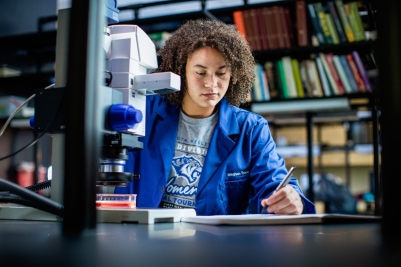
Nicholas Wenande, of Mitchell, is a junior
biology-chemistry major and Spanish minor from Mount Marty College.
His BRIN fellowship brought him to DWU to work
with Dr. Anthony Cole, associate professor of biochemistry, in
the lab using an Agrobacterium expression system to investigate
the development of local and systemic responses to Tobacco Mosaic
Virus infection in Nicotiana gossei.
They will also be looking for new viruses in wheat fields around
the area. |
All the Places
You Can Go…
Science can lead to almost anywhere. Biochemistry and
biology majors can take what they learn in the classroom and apply it
to teaching and/or researching in their fields; working in healthcare
or science-related industries, or perhaps get paid as a science technical
writer. There are multiple possibilities. Here are a few career choices
that someone with a biochemistry degree might choose:
|
Research
Research technician
College professor, researching in own lab
Pharmaceuticals
Biotechnology
Agriculture
Private or government sectors
Industry
Market Research
Product Development and Testing
Aerospace
Scientific Consultation
Patent, Environment, or Medical Law
Biological Entrepreneurship
|
Healthcare
Medical doctor
Physical therapy
Dental healthcare
Pharmaceutical research trials
Medical investigator for the Centers for Disease Control
Research at the National Institutes of Health
Veterinarian
Science writing
Help explain the science in layman’s terms to readers
and television viewers:
Broadcast journalism
Medical journals
Online magazines
Medical online sites
|
(Career choices drawn from Kathleen M. Eyster’s “101 Things
You Can Do With a Degree in
Biology.” For more information, contact Dr. Paula Mazzer at pamazzer@dwu.edu.)
 |
Nick Tolsma, of Rapid City, is a senior at
DWU studying biochemistry and biology with plans of medical school
after college. His BRIN summer research involved
working with Dr. John Dixson, assistant professor of chemistry
at Black Hills State University.
The research is based on natural products chemistry and medicinal-organic
chemistry. They will evaluate plants that the American Indians
used for medicinal purposes and investigate whether they have
activity against diseases of today. The plants may have a potential
to act on other diseases besides the traditional diseases of the
past. The second step is to isolate the compounds that are responsible
for the biological activity and determine their structures.
|
In the News
|
 |
 |