



Biology
Experience Life to Its Fullest
What jobs can you do with a
biology degree?
Begin your career in biology with us, and apply your knowledge in careers such as:
Medicine, dentistry, healthcare or veterinarian
Ecology, microbiology or zoology
Science research or data analysis
Wildlife or environmental management
College or high school teaching
What’s the Difference at DWU?
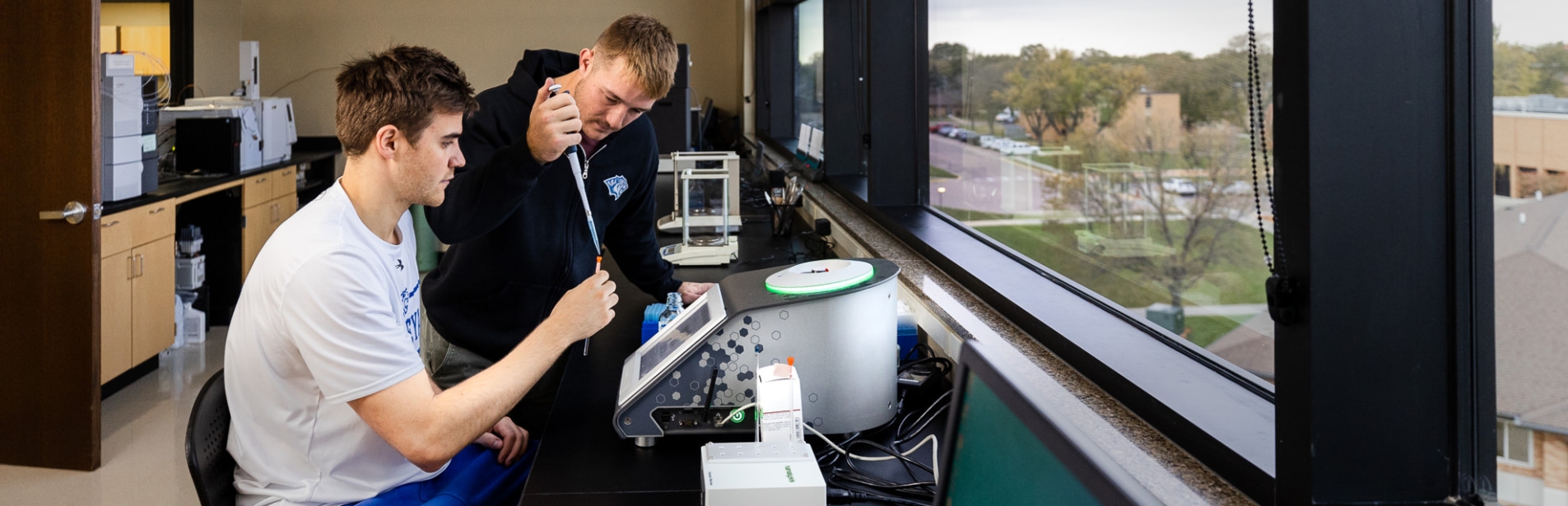
- Beyond class and lab time, you’ll have a variety of practical, hands-on experiences on and off campus.
- You’ll have access to private rural land to conduct research, restoration and preservation of native prairie habitats.
- Research and internship experiences will start as soon as the summer after your freshman year.
- DWU biology majors have completed internships with biomedical laboratories, South Dakota Game, Fish and Parks, zoos and pharmaceutical companies.
Internships
Think globally and consider learning opportunities not available on campus. Apply for an internship to get experience in the field you hope to pursue after you graduate.
Our students have found internships in the following places:
- Belize, studying rain forests and their ecology.
- Romania, assisting a forensic anthropological dig.
- San Francisco, conducting psychology research.
- Vermillion at the University of South Dakota, researching microbiology.
These experiences can lead to permanent positions following graduation.
Biology Courses
Combine classroom lectures with hands-on learning experiences in and out of the lab, internships and research opportunities.
BIO 120 Principles of Biology I
Prerequisite or corequisite: BIO 120L
BIO 120L Principles of Biology I Lab
Corequisite: BIO 120
BIO 122 Principles of Biology II
Prerequisite: BIO 120/120L
Corequisite: BIO122L
BIO 122L Principles of Biology II Lab
Prerequisite: BIO 120/120L
Prerequisite or corequisite: BIO 122
BIO 301 Biostatistics
BIO 315 Genetics
Prerequisites: BIO 122/122L
Prerequisite or corequisite BIO 315
BIO 315L Genetics Lab
Prerequisites: BIO 120 and BIO 122, and prerequisite or corequisite BIO 315.
BIO 316 Evolutionary Biology
BIO 470 Capstone Experience in the Biological Sciences
Prerequisite: by departmental permission only, and students must have documented at least 120 hours of previous field experience, internship, and/or research.
CHM 231 Organic Chemistry I
Prerequisite: CHM 164/166
Corequisite: CHM 231L
CHM 231L Organic Chemistry I Lab
Prerequisite or corequisite: CHM 231
CHM 323L Analytical Chemistry Lab
Prerequisite or corequisite: CHM 323
CHM 332 Organic Chemistry II
Prerequisite: CHM 231/231L
Corequisite: CHM 332L
CHM 332L Organic Chemistry II Lab
Prerequisite or corequisite: CHM 332
MTH 210 Calculus I
Prerequisite: MTH 135 or math placement.
PHS 260 University Physics I
Prerequisite: MTH 210
Corequisite: PHS 260L
PHS 260L University Physics I Lab
Prerequisite or corequisite: PHS 260
Get to Know Your Professors
Discover biology with our knowledgeable professors! Our low student-to-teacher ratio offers valuable one-on-one interaction with professors.
Brian Patrick, Ph.D.
Julie Olson, Ed.D.
Kat Sestrick, Ph.D.
Paula Mazzer, Ph.D.
The Experience
Find Your Strength in Biology
Become a more marketable asset in your area of concentration and be better prepared for your future career. Select one area as your concentration to focus your studies and dive deeper into the world of biology.
Concentration in Cell Biology
The allied health fields and the biological sciences often center their work around molecular or cell biology. Develop your knowledge of some of the smallest components of our bodies and the organisms around us. With this concentration, you can get personal experience identifying processes and patterns of cells through labs in our state-of-the-art facilities. Your concentration in cell biology will keep you on track to continue your education in professional health sciences or in postgrad research.
Take classes like:
- Microbiology
- Molecular and Cell Biology
- Biochemistry
- Anatomy and Physiology
- Immunology
- Invertebrate Zoology
- Botany
- Ornithology
- Mammalogy
- Ecology
- Principles of Wildlife Management
Concentration in Ecology and Evolutionary Biology
When you add this concentration to your major you will investigate individual organisms, their populations and their ecosystems. Connect your knowledge of each and see their effect on the entire globe. Courses within the ecology and evolutionary biology concentration focus on the interactions and evolutionary history of organisms and populations of organisms, as well as the biotic and abiotic interactions and functions of ecosystems, biomes and the biosphere. Many of the classes in this concentration have outdoor labs that will give you hands-on field experiences. That’s right. Field trips.
Take classes like:
- Ecology
- Botany
- Mammalogy
- Ornithology
- Principles of Wildlife Management
- Microbiology
- Immunology
- Molecular and Cell Biology
- Biochemistry
- Anatomy and Physiology
- Invertebrate Zoology
Concentration in Organismal Biology
Spend time studying animal and/or plant sciences, how organisms are identified and classified, how an organism’s structure is related to its function and the general biology of organisms. You’ll explore the branch of biology that involves the behavior, composition and organization of organisms. Dive deeper into molecular structure and genetic makeup to help you understand entire organisms. Many of your classes in the organismal concentration have weekly labs. Labs are traditional some of the time but also require spending much of your time in the field studying your subjects. Yep. We said it. Field trips, in college.
Take classes like:
- Invertebrate Zoology
- Botany
- Microbiology
- Anatomy and Physiology
- Mammalogy
- Ornithology
- Molecular and Cell Biology
- Biochemistry
- Ecology
- Principles of Wildlife Management
Do I need a minor if I have a concentration?
If you have decided on a Bachelor of Arts in biology and add an area of concentration, you will also need to choose a minor. Many minors will complement a biology major. Accentuate your love for science with a chemistry minor or let your love for the arts shine with a music minor. The possibilities are endless.
If you are taking the Bachelor of Science track in biology, you do not need to worry about a minor.
Related Majors & Minors
Biology Education
Open young minds to the wonders of science! Become a biology teacher.
Biochemistry
Explore the world around you! Learn from science professionals in state-of-the-art facilities and in the field.
Chemistry
Love being in the lab? Develop your interest in the physical sciences with a chemistry minor at DWU.