




![]() |
|
|
|
Back row: Heidi Birkley, Coordinator Tina Hartley, Holly Schramm, Laura Guericke, Renée Butler. Front row: Mike Molitor and Heath Eggleston (not pictured, Paula Mettler) Mission Statement: “Our mission is to inspire confidence through example in new students as well as current classmates. Our goal in the Peer Mentoring Program is to give help where help is needed and to make it known that asking for help is not weakness; rather it is a way to build one’s self. We as Peer Mentors pledge to devote our resources to whom or where ever it may be needed” – 07-08 Peer Mentors Training Retreat at Storm Mt.
Peer Mentors as Orientation Leaders at New Student Orientation
Events Super Size Me: Dayton Lobby @ 9pm on
Sunday, September 30th
Thanksgiving Safety Training, November 14th, 2007
Finals Stress Night – Christmas Vacation
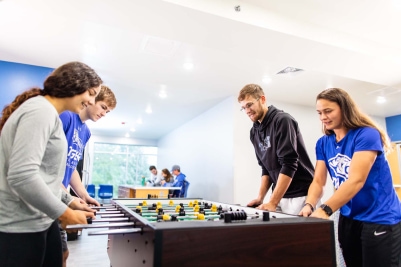
TRiO Ice Cream and Game Social
Facebook Presentation by Laura Guericke and Holly Schramm
Grad School Presentation by Renée Butler and Heath Eggleston
TRiO Ice Cream Social
Communication Workshop Presentation
My Best Advice on Communication… Face to face communication is a very important tool in the world we live in. If you do not learn effective face to face communication, it will really show in your job interviews and other such situations. Email is a quick way to tell someone something, but if you need to say something important, be sure you are looking the receiver in the eye. ~ Heath Eggleston Communication is key in every relationship you are involved in. Work on expressing yourself clearly and also on being a good listener. Whenever possible, try to talk face-to-face and minimize emails and text messages, since things can easily be misunderstood these ways. If you must write an email, keep it grammatically correct, and don't use shortened phrases too much. Try to write your email in the same way you would talk to that person. ~ Renée Butler Communication occurs millions and millions of times day. It takes place all the time and in many different contexts. Presentations, introductions, emails (formal and non-formal), and day-to-day chitchat are just a few different types communication that happen on a daily basis. **If you are in a formal situation, there are a few tips that you should follow:
**If you are in an informal situation, it is not nearly as important to follow specific rules but it is wise to maintain eye contact and also remember to be an active listener. What you say is just as important as what the other person is saying. ~ Laura Guericke **It is best to talk with someone face-to-face to avoid any miscommunication errors of wrong tone or message. People are more likely to understand your message the way that you deliver it if you speak to them instead of sending an email, text, or other electronic message. As far as having good communication skills: try to speak clearly and to the point. Try to avoid unwanted slang that may confuse a message. Speaking properly and using good grammar may even improve writing skills with proper grammar. ~ Holly Schramm Communication skills are so important to everything that we do. The best advice I can give is that if you have something important to say, it would be better to say it in person instead of through email. Emails and letters can be interpreted wrong. And when you are talking to someone - look them in the eyes and speak clearly. Also a huge part of communication is listening! ~ Paula Mettler Communication: do it face to face. Face to face communication will get you a lot farther than any other type, especially with your professors. Communicating face to face lets that person know you care, that you’re interested; and there is a less change of your message getting discombobulated. ~ Heidi Birkley My best advice on communication would be to be clear in what you are trying to say. When you are writing something in an email or letter or paper or anything, don't just assume that the other party knows what you mean- be thorough. Also- if and when you text message, make it a habit to use proper grammar and not take shortcuts in your words: when people read this kind of thing in other types of communications media (email, papers, nearly anything) they realize that you don't have the necessary skills for communication. When speaking to people, listen to what they have to say, don't just hear their words. Lean into the conversation, make confirmed eye contact, and be concerned in what they have to communicate to you. Be genuine...be yourself. ~ Mike Molitor |
||||||||||||||||||||||||||||||||||||
| Dakota Wesleyan University 1200 W. University Ave Mitchell, SD 57301 800-333-8506 |
||