

Wesleyan Today

Spring 2002

a publication for alumni, family, and friends

    
Technology and a liberal arts education

Gloria Hanson
University Relations

A decade ago, computer courses at Dakota Wesleyan consisted of students learning the difference between megabytes and gigabytes. They were taught the historical aspects of the computer age and learned that the first computers were so large that it took an entire room to house them.

English professors introduced students to their first floppy disks and taught them enough word processing skills to write term papers. Faculty and staff picked up the telephone if they needed to talk to someone in another building, and the only mail delivered to campus came from the U.S. Postal Service.

The Layne Library was the site students chose to conduct research, and the Internet and the World Wide Web were things students only heard about on the nightly news. Times have changed at Wesleyan and technology gets the credit.

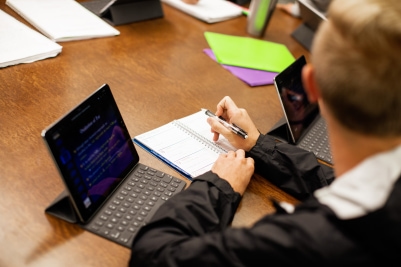
Today, professors teach courses over the Internet and students use laptops in the classroom. They design Web sites, compose music on their laptops and mix still photography with sound to produce their own videos.

Students know the difference between hyperlinks and hypertext, GIFs and JPEGs. They research material from an Internet library with more than a billion books, all scattered in no discernible order and with no card catalog.

The entire campus is now connected by an intranet system that delivers e-mail to every student and employee on campus, and technology in some form is used in nearly every classroom.

Melissa Gibson, assistant professor of computers and technology, teaches computer applications courses, Web page design and desktop publishing. She says it's essential for students receiving a liberal arts education to know how to use the technology available today.

"It is very important because it's going to hit them in the work world no matter what they go into," she said. "Technology today is such a useful tool for learning and it can help our students think better."

Two years ago DWU piloted a program that required laptop computers for students majoring in music and those with minor studies in computers and technology. The program expanded last fall to include 100 education students, and the computers and technology minor has expanded to a major with several emphases. More changes are in store for the wireless program next year, and all students could be required to have laptops in the classroom in the
not-so-distant future.

Gibson makes a point of developing curriculum that gives her students hands-on experience using their laptops. Last semester her graphic design class designed the ads for one issue of the Phreno Cosmian, DWU's student newspaper and will continue the practice next year.

"It was the best work my students did all semester because they knew people would see their designs," Gibson said.

Gibson also said that by learning PowerPoint and Web page design, students learn better research skills and have an edge on others who may apply for the same job, but lack the computer training.

In Wesleyan business courses, students develop spreadsheets and databases and complete accounting projects using special software. Smart Classrooms, or multimedia instructor lecterns, aid professors in teaching and give Wesleyan students an advantage over those at other schools.

The lecterns allow instructors to use PowerPoint software to project images and words onto a screen. DWU biology professor Bob Tatina said he uses the software in nearly all his lectures and says students are more attentive to the on-screen images, but they also tend to read less in their textbooks.

"Technology has its good points and its bad points," he said.

Tatina, who has worked at Wesleyan for more than 20 years, says he remembers when the university loaned faculty members $1,000 to purchase an IBM personal computer for their home. He also recalls the days when the faculty in Science Hall shared just one computer.

"What's great now is that I can connect to the databases in the library right from my office," he said. "We used to have to fill out a request and then wait." Tatina also said that access to the Internet has been wonderful for him and his students.

Paul Almjeld, associate professor of music and director of choral music activities, uses laptops in his classroom. Students compose music on them using special software, and he uses the laptops to teach music theory.

Almjeld attended the Technological Directions in Music Learning Conference earlier this year, sponsored by the Institute for Music Research at the University of Texas at San Antonio. At the conference, he had an opportunity to hear how other universities use technology in their classrooms.

"Our program is on the front bumper. It's really cool," he said. "Other schools have major computer labs dedicated for music, but because we don't have the space or facilities, our laptop program is ideal. We have leading-edge technology that you don't find at some of the larger schools."

Almjeld said he submitted a proposal to make his own presentation at next year's conference and plans to share how Wesleyan has integrated the laptop program into music education.

Being a teacher today requires a high comfort level with technology. Sylvia Street, administrative chair of the education department, says education majors are required to complete professional electronic portfolios.

Courses in the education department take students through the electronic portfolio development process. They begin in an early course by coming up with ideas and a table of contents for their portfolios, then they learn the formatting in another course. By the time an education student graduates, he or she has a complete collection of work and experience on a compact disk.

"Everything in the 21st century in education says it's not good enough to just say you can do it. You have to prove it," Street said.

The days of enormous computers and technology reserved for scientists are gone. Whether headed for the classroom or the boardroom, Dakota Wesleyan University students in the 21st century are ready to prove their technological expertise.


Dakota Wesleyan University
1200 W. University Ave
Mitchell, SD 57301
800-333-8506