












Interpretation of The Saint John's Bible: Esther the Queen
April 9, 2026
By Joel Allen, Ph.D., Professor of Religion and Philosophy
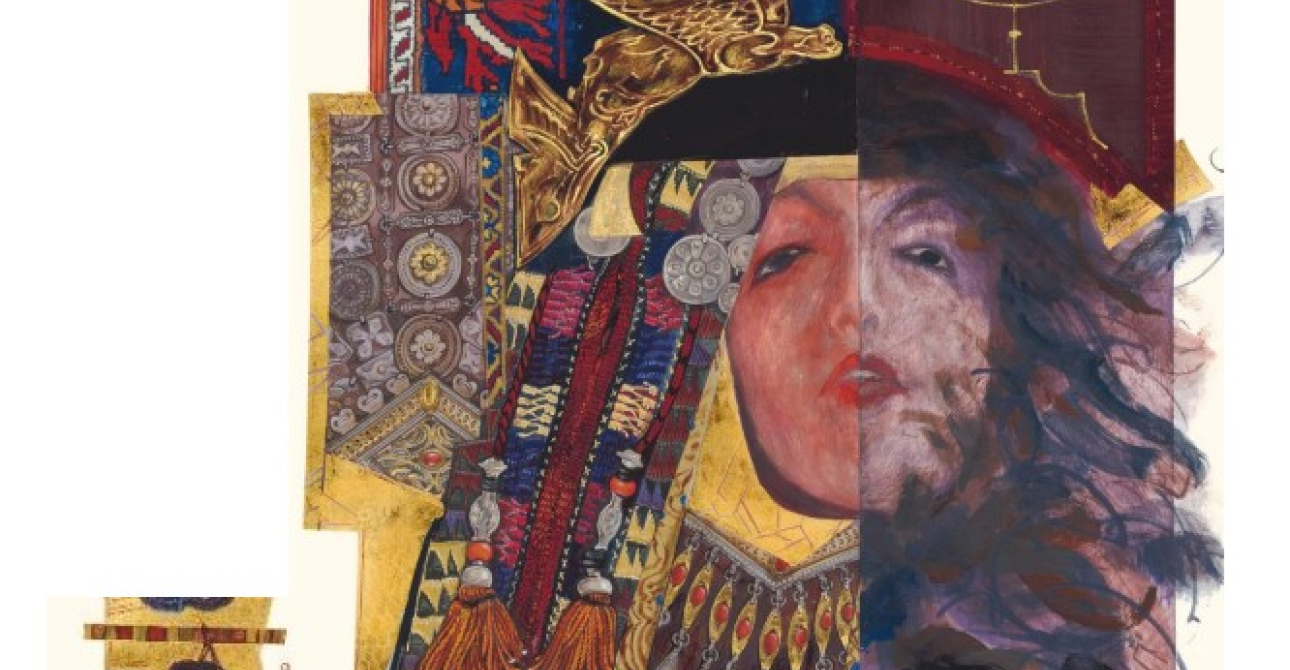
The illumination captures Esther not at the moment of triumph, but at the moment of tension and terror. Her face is divided. Her left side radiant with gold and order, the other shadowed and unsettled. A plot to execute the Jews is forming, and Esther has been encouraged by her uncle Mordecai to inform the emperor, even though she had not been summoned to the throne room. She is risking her life by entering his royal presence.
On one side, she is Esther the Queen — protected, admired, powerful. On the other, she is the Jewish Hadassah whose life is suddenly bound to the fate of her people. Mordecai, her uncle, sent her a message that shatters any illusion of safety: “Do not think that in the king’s palace you will escape any more than all the other Jews,” (Est. 4:13). The illuminator, Donald Jackson, does not portray Esther as whole and settled because she is not.
In the Hebrew text of Esther, God is never named or invoked in prayer. But in the Greek version of the story, Esther prays, and The Saint John’s Bible makes sure we hear her voice. She prays not as a queen, but as a servant: “Lord, you alone are our King. Help me, who am alone and have no helper but you.” Esther does not pray for success. She prays for faithfulness. She cried out, “O God, whose might is over all, hear the voice of the despairing and save us from the hands of evildoers. And save me from my fear!”
The floating crown in the image is perhaps its most haunting detail. Esther’s authority is real but fragile. One wrong move and many die. To approach the king uninvited is to risk death, and Esther knows it. Her words are not triumphant; they are resolute: “I will go to the king, though it is against the law; and if I perish, I perish.”
Mordecai’s words echo through time: “Who knows? Perhaps you have come to royal dignity for just such a time as this.” Esther steps forward not because she is certain of the outcome, but because she trusts that faithfulness matters — even if she never sees the result. This illumination invites us to stand where Esther stands between fear and faith, between silence and speech, between safety and sacrifice.
The man she most feared, Haman, is seen hanging dead, having received his just reward. God did indeed save Esther from her fears.
Courage doesn’t demand freedom from fear. Courage is the strength to not let fear have the last word.
Esther (detail), Donald Jackson, © 2010 The Saint John’s Bible, Saint John’s University, Minnesota, USA. Used with permission. All rights reserved.